
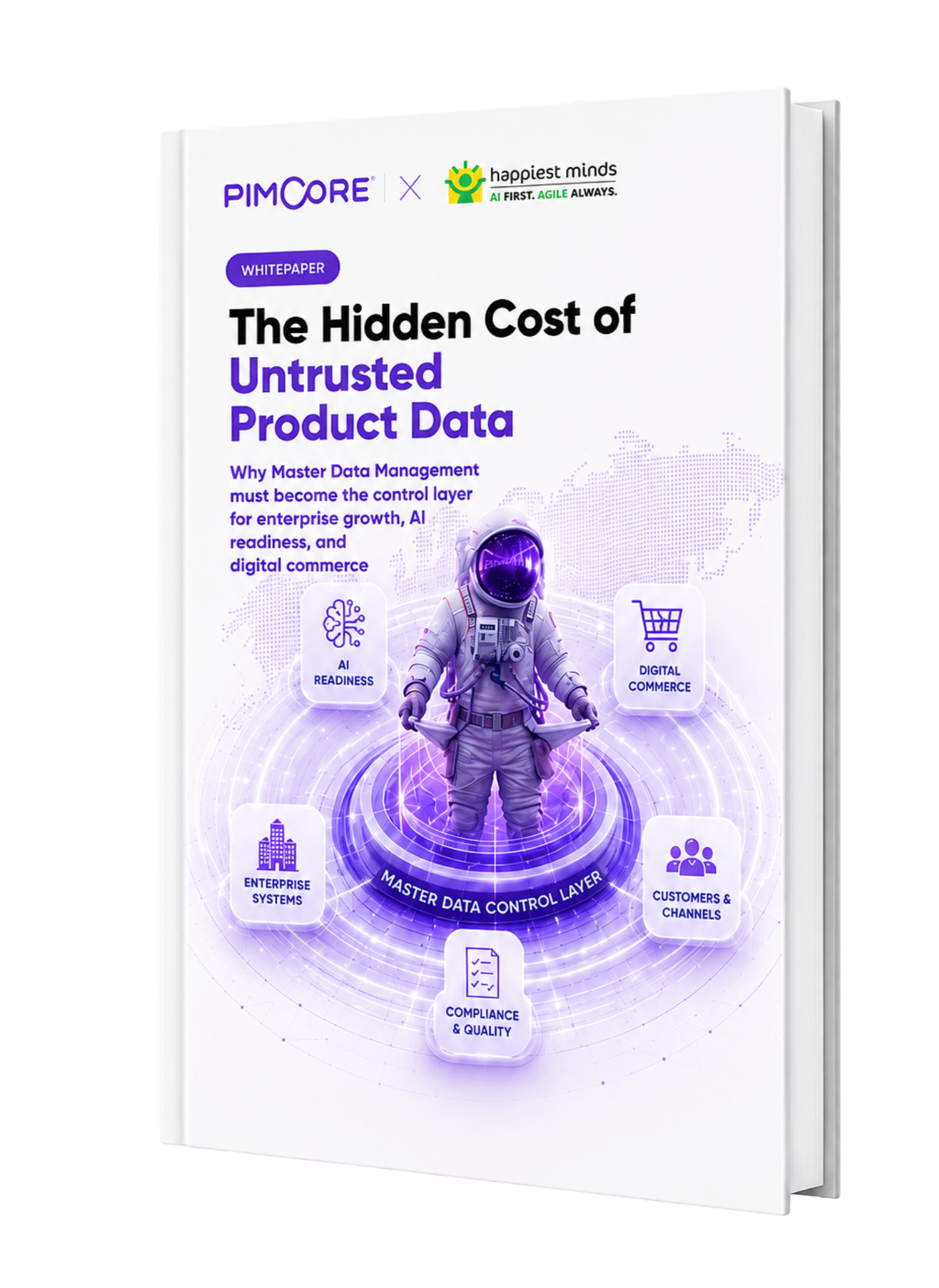
Why Master Data Management must become the control layer for enterprise growth, AI readiness, and digital commerce
Untrusted product data rarely creates one obvious failure. It creates repeated friction.
A launch takes longer than planned. A marketplace rejects a listing. A compliance request triggers manual searching. An AI pilot cannot scale because the source data is not trusted.
These moments often look like operational noise. In reality, they are hidden costs distributed across teams, systems, workflows, and markets.
In this whitepaper, Pimcore and Happiest Minds reveal where product data trust typically breaks, why the cost is often hidden, and what measurable business impact companies can unlock when MDM becomes more than a data repository.
Inside, you will see real-world MDM impact examples, including how enterprises achieved:
- 90% reduction in duplicate records through intelligent golden record management
- 85% faster golden record creation across products, customers, and vendors
- Less manual effort, stronger governance, and faster execution across complex data landscapes
- And many more insights that show what trusted product data can unlock at scale
See where product data trust breaks, what it costs, and how MDM can help enterprises move faster with trusted data. Fill out the form to get your copy.
Product data trust breaks quietly. The business impact does not.
Where untrusted product data creates friction

Manufacturing and B2B sales
Manufacturers manage complex product structures, configurations, spare parts, distributor catalogs, technical documentation, and compliance requirements. When this data sits across ERP systems, spreadsheets, PDFs, and local repositories, teams spend too much time searching, validating, and correcting information.
The result is slower distributor activation, inconsistent product information across markets, and higher operational effort.

Retail and marketplaces
Retailers and commerce teams need to move fast across marketplaces, eCommerce channels, regional assortments, and seasonal launches. But when product attributes, images, packaging details, compliance information, and channel requirements are managed across disconnected systems and spreadsheets, execution slows down.
The result is rejected listings, delayed launches, inconsistent customer experiences, and revenue that should have been captured when demand was highest.

AI and automation
AI depends on trusted data. If product relationships, classifications, ownership, lineage, and governance are incomplete, AI use cases become difficult to scale.
The result is risky recommendations, unreliable outputs, manual review cycles, and automation pilots that cannot move into production with confidence.
What this whitepaper will help you understand
✔ Inside the whitepaper, you will learn why product data issues are often invisible on the P&L but highly expensive in execution.
✔ You will see why MDM must move beyond being a repository or technical governance project and become the enterprise control layer for trusted product data.
✔ The whitepaper explains how business leaders can shift the conversation from data management to business execution, how MDM maturity moves from fragmented to controlled, and why AI needs governed, contextual, and explainable product data.
✔ It also introduces the Pimcore Data Spine as an operating model for trusted product data across systems, channels, analytics, commerce, and AI environments.



Niche Player in Magic Quadrant MDM

Leading Solution for Data and Experiences

MarketScape for PIM/MDM
Customers' Choice & Magic Quadrant DXP

Visionary, PIM Value Index

5/5 from more than 80 reviews


Copyright © 2026 Pimcore, All Rights Reserved Privacy policy Terms