
Pimcore Platform Version 2026.3 focuses on making everyday data work faster and more reliable, while laying important foundations for extensible portal experiences, semantic discovery and agent-driven automation.
Building on a modern platform foundation
With Pimcore Platform Version 2026.3, we continue to strengthen the areas that matter most in real-world enterprise projects: performance at scale, operational reliability, efficient content and data management, and extensibility without unnecessary complexity.
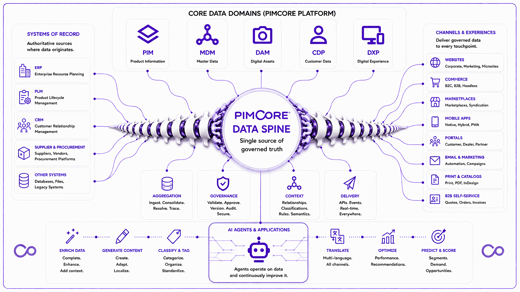
These are foundational components of Pimcore's Data Spine strategy, significantly strengthening the existing agentic data layer to support highly demanding enterprise use cases and massive data volumes across all Pimcore capabilities.
This release brings substantial improvements to the Generic Data Index, a reworked architectural direction for Pimcore Portals, an embeddings capability for semantic search and similarity detection, secure OAuth 2.0-based integration capabilities for external tools and AI agents and another beta iteration of the Pimcore Agent Bundle. At the same time, a broad set of usability and maintenance improvements makes recurring tasks across grids, search, assets, document editing, version history, and backend operations more efficient.
The result is a release that improves the platform in two dimensions at once: it makes established workflows more dependable today, while preparing Pimcore for more modular, intelligent, and automation-driven product experience management in the future.
Everyday productivity improvements across the platform
Platform Version 2026.3 reduces friction in daily work with a broad set of improvements that make common tasks more efficient for editors, data managers, and project teams.
More capable grids and data listings
Data listings continue to become more practical for operational work. A new user modification system column is available for objects, making it easier to see who last changed an element directly in a listing. Asset lists can now be filtered by file size, which is especially useful when reviewing large media repositories, identifying unusually large assets, or preparing optimization and cleanup activities.
Batch editing has also been improved for multilingual environments. Teams can now edit multiple languages simultaneously in batch edit mode, reducing the amount of repetitive work required when maintaining localized product information or other structured content across markets.
Faster, more consistent search and navigation
The search input is preserved when users switch between element scopes. This helps users stay in context instead of repeatedly entering the same search term while moving between different scopes in the search.
Asset management that remembers how you work
Image size settings for asset previews are now stored per folder and persist across login sessions. For users working with different types of asset collections, this means the preview can remain optimized for the content of each folder instead of being reset every time a session ends.
Flexible dialogs
Modals can now be moved, which helps when a dialog obscures information users need to reference while completing a task.
Enhanced editing ergonomics for the Document Editor
The Document Editor has also received usability refinements. Its sidebar can be resized, and text fields can grow automatically with their content. These changes make longer values easier to edit without forcing users into cramped input areas.
Clearer version history
The Versions interface has been simplified by removing redundant "open" labels, while data objects now include a Properties section in the version view. This provides additional context when reviewing element history and makes it easier to understand how an object has changed over time.
Index snapshot export/import commands
Adds two console commands that let an installation's search indices be exported to a portable bundle and imported into another installation in minutes, without a full reindex.
Pimcore Experience Portals rework: extensibility without forking the core
The experience portals frontend is being reworked - the first of several steps toward modernizing and improving the experience portals.
With this release, the experience portal design has been modernized and aligned with Pimcore Studio. It also includes usability improvements based on the first round of customer feedback (e.g. improved layout and responsiveness, improved navigation & filtering…), with more to follow in the coming releases.

Underneath, the frontend moves to an entirely new technological basis. This addresses one of the central challenges of experience portal projects: how to add customer- or project-specific functionality without modifying the core and creating upgrade risk. The previous experience portal frontend is built on an older stack that is separate from Pimcore Studio, so extending it can require changes close to the core, which increases maintenance effort and can make updates more difficult. The new approach replaces this with a shared frontend foundation and a clear extension model - better extension and customization options, and a solid base for future portal capabilities.
Backwards compatibility: the new frontend uses the same URLs, so existing shared links continue to work. In addition, the frontend can be switched per portal via configuration - existing portals and their extensions keep working exactly as before. Support for the old frontend stack will be removed with 2027.1.
A stable SDK and plugin-based extension model
The reworked Portal Engine uses a Module Federation-based plugin and extension system. The portal will expose a stable SDK, while separate plugin packages can add custom user interface functionality at defined extension points, or “slots.” Plugins can be enabled per portal, allowing projects to tailor functionality without forking the core.
Pages remain server-rendered to preserve good URLs and performance. The most important architectural change, however, is the separation between the portal core and project-specific extensions.
What this means for partners and customers
For Solution Partners, the new architecture creates a clearer and more scalable way to deliver customer-specific portal functionality. Features can be developed as plugins and reused where appropriate, while the core can continue to evolve behind a stable SDK and extension boundary.
This approach is also intended to reduce upgrade friction. Existing partner implementations should be less tightly coupled to internal portal code, and previously shared portal links remain supported. In parallel, interface improvements and feedback from real-world partner projects will be incorporated into the new portal experience.
The broader goal is a modern and maintainable frontend direction aligned with Pimcore Studio, while still preserving the specific requirements of portal-style applications.
portal-ui-kit: a reusable foundation for future portal-style applications
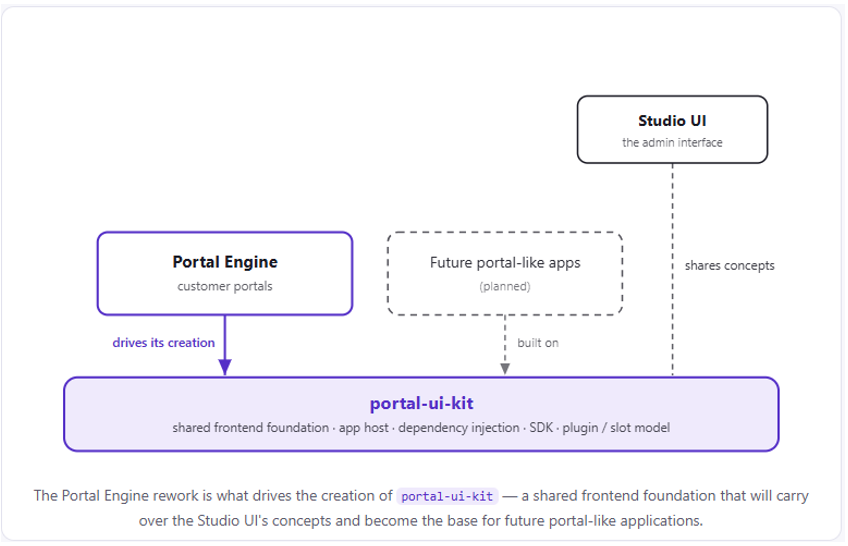
The Portal Engine rework is also leading to a reusable frontend foundation called portal-ui-kit. It shares core architectural concepts with the Studio UI, including the application host, dependency injection, SDK, and plugin/slot model, while allowing portal-style products to evolve independently and use components that fit their own needs.
Going forward, portal-ui-kit is intended to become the base for additional portal-like applications. Rather than creating each application from scratch, new products can build on a shared architecture and SDK. This gives the Pimcore product family a more consistent architectural language and gives partners a clear extension model to target.
Building on this powerful new foundation, we're taking Pimcore Portals to the next level with even more capabilities and an enhanced user experience. Upcoming improvements will include data object editing, the ability to add new users directly within the Pimcore Portals, a range of UI enhancements, and much more.
Pimcore Embeddings: exploring semantic search and similarity detection
Platform Version 2026.3 also introduces an embeddings-based capability for assets and data objects. The goal is to provide a reusable service that generates vector embeddings from images and textual metadata, enabling two new capabilities: semantic search and duplicate detection.
These embeddings are designed to be stored in a search-optimized backend so they can be queried efficiently. An adapter-based architecture was introduced to keep the embedding provider flexible, allowing Pimcore to support its own inference service as well as third-party services.
Search by meaning, not only by exact keywords
Semantic search changes how users can discover content. Instead of relying only on exact field values or keyword matches, users can search based on the meaning or visual content of an asset. A user could, for example, describe the type of image they are looking for in natural language and retrieve visually relevant results.
The same foundation can support image duplicate detection by identifying visually similar or near-duplicate assets. For data objects, embeddings derived from object content can be used to detect potentially duplicated or highly similar records.
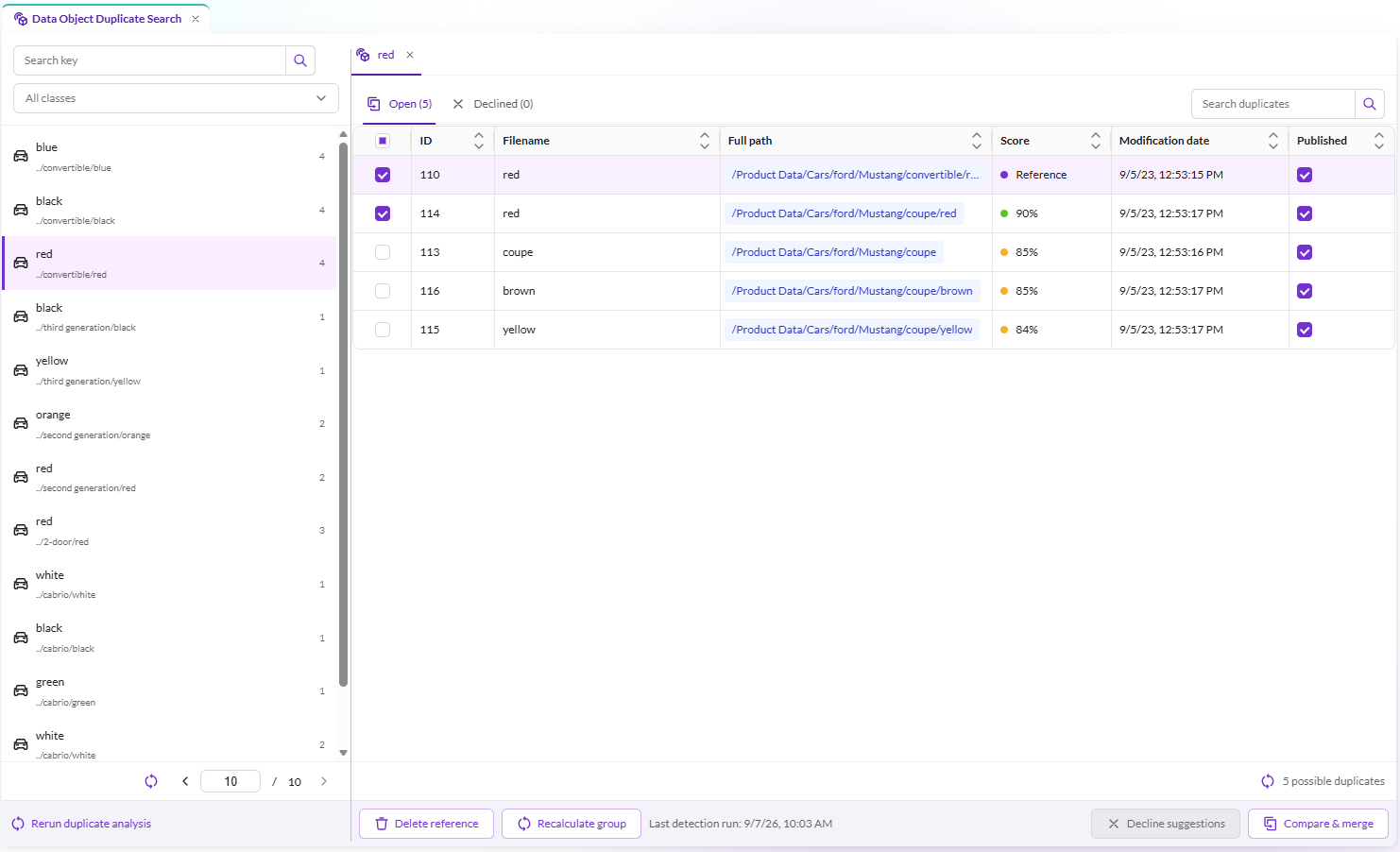
The concept is also intended to integrate with the standard search experience, making embeddings available across multiple parts of the platform rather than limiting them to a single specialized tool.
The business value: faster discovery and better content quality
For teams managing large media libraries or structured content repositories, the benefit is straightforward: relevant content can be found faster, duplicates can be identified more easily, and less manual effort is required to compare assets or records. The result is a more intuitive, content-aware search experience that better reflects real-world similarity.
For more information, please refer to the documentation.
Securely connecting Pimcore to the AI agent era
As external tools, AI agents, and chat assistants become an increasingly important part of digital workflows, secure and standardized authentication becomes essential. Pimcore is evolving into a full OAuth 2.0 server built on the existing Pimcore user system, creating a stronger foundation for secure integrations without introducing a separate identity layer.
This allows access authorization of any kind of third party applications to Pimcore. This will be increasingly utilized by Pimcore itself (see Datahub Simple REST below, with more to come), as well as by custom Pimcore extensions.
Native OAuth 2.0 for Datahub Simple REST and MCP integrations
With native OAuth support, Datahub Simple REST and its Model Context Protocol (MCP) capabilities which is now available as a final version can be connected securely to third-party applications and AI agents using standardized authentication. This removes the need for project-specific authentication workarounds and makes it easier to integrate Pimcore into modern AI-driven architectures.
External agents and AI chat applications can authenticate against Pimcore while continuing to rely on existing Pimcore user accounts. This avoids duplicate identity management and helps organizations keep access control anchored in the user and permission structures they already operate.
A future-ready authentication foundation
For customers and Solution Partners, this means a more consistent way to connect Pimcore with the growing ecosystem of external applications, AI agents, and conversational interfaces while continuing to use established Pimcore identities and access controls.
Datahub Simple REST: MCP support reaches final
Model Context Protocol support for Datahub Simple REST received various improvements and bug fixes and is now available as a final release in 2026.3.
For more information, please refer to the documentation.
Pimcore Agent Bundle: expanding beyond the Studio interface
The Pimcore Agent Bundle continues as a beta pre-release in Platform Version 2026.3, with improvements that make Pimcore Agent easier to integrate into broader automation scenarios.
Headless Agent Tasks for integrations and automation
A key addition is support for headless Agent Tasks. These tasks allow Pimcore Copilot as well as external tools and integrations to delegate work to Pimcore Agent and retrieve the resulting output.
This is an important step beyond an agent that is only available through a user interface. Agent capabilities can now become part of automated processes, integration flows, and other applications that need to invoke Pimcore intelligence programmatically.
Agent capabilities inside Pimcore workflows
The bundle now also integrates with the Pimcore Workflow Engine. This makes it possible to bring agent capabilities into existing business processes and workflow-driven automation, connecting AI-assisted execution with the same process logic that already governs enterprise data and content operations.
Further configuration improvements, UI enhancements, and bug fixes improve the overall usability, stability, and flexibility of the beta bundle.
For more information, please refer to the documentation.
Generic Data Index: performance, stability, and traceability
The Generic Data Index powers search, grids, and listings across the Pimcore Platform. In 2026.3 we've made indexing faster, more resilient, and easier to observe.
Faster at scale. Profiling large customer installations showed the same work repeating. Tags are now fetched once instead of per element, localized fields no longer normalize the whole dataset to read a few keys, and inheritance resolution is cached across shared parent chains. That removes one SQL query per element and cuts normalize and extraction time in multi-language, inheritance-heavy setups. Queue workers also release memory between batches, keeping long runs within predictable bounds.
Calculated fields. Set calculated_fields_index_mode to query_store and Pimcore indexes stored values instead of re-running every calculator on each reindex. The values stay searchable, filterable, and sortable. Existing installations are unaffected unless you opt in.
More resilient. A temporary cluster failure during a native reindex no longer recreates your live index. Configuration-only changes, like reordered languages, no longer trigger a full reindex. Descendant paths update reliably after moves and renames, so elements stop disappearing from search, grids, or trees.
Better visibility. Indexing now has its own log channel and dispatch IDs for tracing queue batches, plus a read-only generic-data-index:status command reporting queue depth, document counts, and interrupted reindexes.
One thing to check before upgrading: update:index now exits non-zero when a section fails. Pipelines that previously treated partial failures as successes will start catching them.
A release focused on scalable operations and future-ready experiences
Pimcore Platform Version 2026.3 combines pragmatic improvements with forward-looking platform investments. Faster and more resilient indexing helps large installations operate more efficiently. Everyday usability enhancements reduce friction for editors and data teams. Native OAuth 2.0 capabilities provide a standardized security foundation for connecting external tools and AI agents. The Portal rework introduces a cleaner extensibility model for partner projects. Embeddings open the door to semantic discovery and similarity-based use cases. The Agent Bundle continues to expand Pimcore's automation capabilities beyond the user interface.
Together, these improvements reinforce Pimcore's direction as an open, modular, extensible platform for Product Experience Management and Data and Experience Management-built to support both today's enterprise workloads and the more intelligent, agent-driven workflows ahead.
Stay informed with Pimcore Inside
Get an exclusive look behind the scenes of Pimcore Product Development with the ongoing Pimcore Inside video series on YouTube. Hear directly from the team building and evolving the Pimcore Platform as they share insights into the latest innovations, upcoming product roadmaps, and key technology developments.

From new features and architectural improvements to technical deep dives and a closer look at what's coming next, Pimcore Inside gives you a first-hand perspective on how the platform continues to evolve and how these advancements can help you get even more value from Pimcore.