

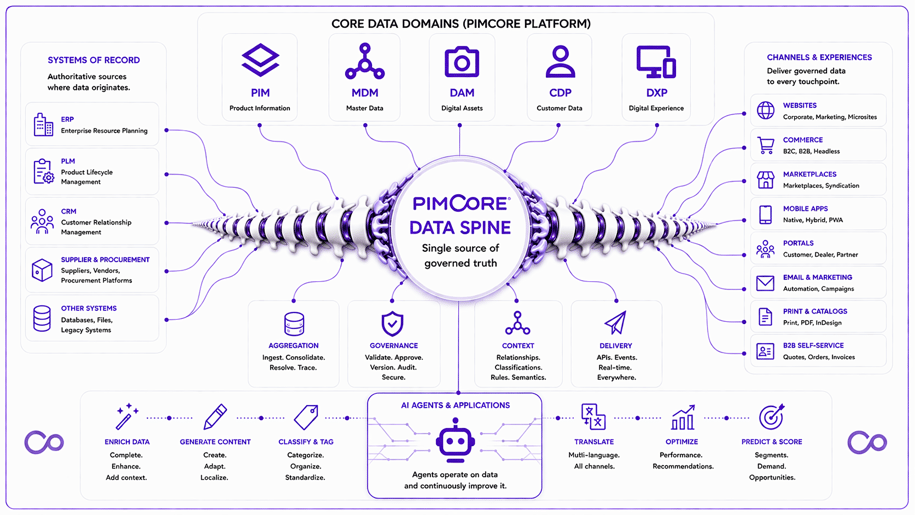
Three converging trends make the Data Spine architecture not just relevant but essential.
The AI Dependency
As discussed above, AI amplifies whatever data foundation it sits on. Good foundation, powerful results. Bad foundation, compounding errors. The Data Spine provides the trusted, governed, contextual data that AI systems need to operate reliably.
And there is a subtlety here that goes beyond data quality. AI agents need semantics. They need to understand not just what a data value is, but what it means, how it relates to other data, and what rules govern its use. The Data Spine, because it maintains explicit data models, relationships, classification systems, and business rules, provides exactly this semantic layer. This is what separates enterprise-grade AI from glorified autocomplete.
The Regulatory Pressure
The regulatory landscape around data is tightening rapidly. NIS 2, DORA, the EU Cyber Resilience Act, the EU Data Act, GDPR enforcement actions — all of these impose requirements on how enterprises manage, govern, and protect data. Regulatory compliance is no longer something you bolt on after the fact. It needs to be structural.
The Data Spine, with its built-in governance, audit trails, permission systems, and data lineage, provides a structural answer to regulatory compliance. It does not eliminate the work of compliance. But it ensures that the foundation is compliant by design, not by workaround.
The Sovereignty Imperative
A growing number of enterprises — particularly in Europe, but increasingly globally — are recognizing that data sovereignty is a strategic concern. Depending on a SaaS platform that stores your data in someone else's cloud, governed by someone else's terms of service, processed by someone else's AI models, is a risk that boards and regulators are no longer willing to accept.
Pimcore's architecture is uniquely positioned here — because Pimcore runs everywhere.
In the public cloud. In a private cloud. In a fully managed PaaS. On-premise in your own data center. This is not a theoretical deployment matrix. These are production-proven deployment models that enterprises choose based on their specific governance, regulatory, and sovereignty requirements.
A financial services company subject to DORA can run Pimcore on-premise within its own security perimeter. A mid-market manufacturer that wants operational simplicity can use the fully managed PaaS and focus on business outcomes instead of infrastructure. A government-adjacent organization can deploy in a sovereign cloud environment that meets national security requirements. A global enterprise can run different instances in different jurisdictions, governed by local data residency rules.
The platform is the same in every scenario. The data model, the governance layer, the API surface, the agent framework — all identical regardless of where it runs. What changes is who controls the infrastructure. And that decision stays with the enterprise.
As an open platform, the code is auditable. There is no vendor lock-in at the infrastructure level. There is no forced migration to a specific hyperscaler. The data stays where the enterprise decides it stays — and moves only when the enterprise decides it moves.
This brings a fundamentally different level of governance and sovereignty than any proprietary SaaS vendor can offer. In a market where almost every competitor operates exclusively on hyperscaler infrastructure with no alternative deployment option, this is not a feature. It is a structural differentiator.


-1.svg)
.svg)
.svg)
.png?width=24&height=24&name=Data%20and%20Experience%20icons%20(1).png)
.svg)


