Customer Data Platform (CDP)
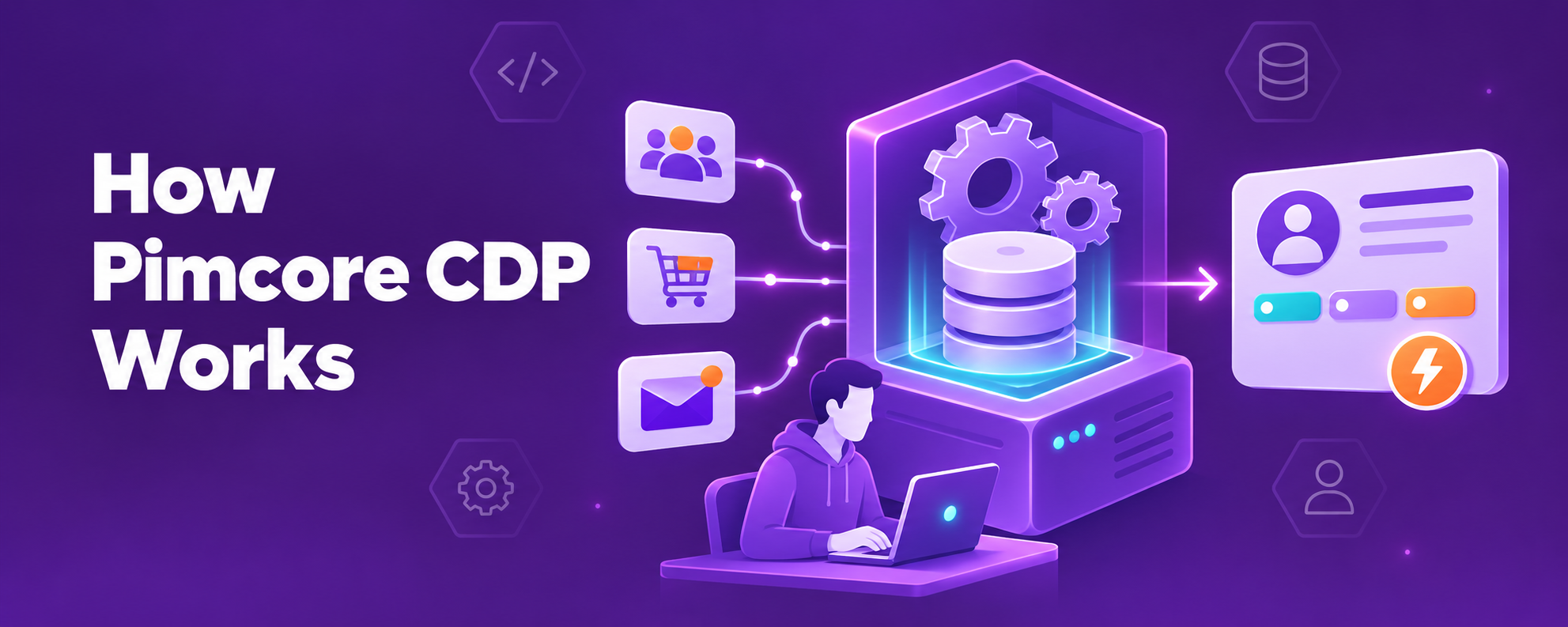
Your CRM, shop, ERP, and marketing tools each know a piece of the customer, and none of them agree on who that customer is. Pimcore CDP merges it all into one profile per person, so every channel acts on the same picture.
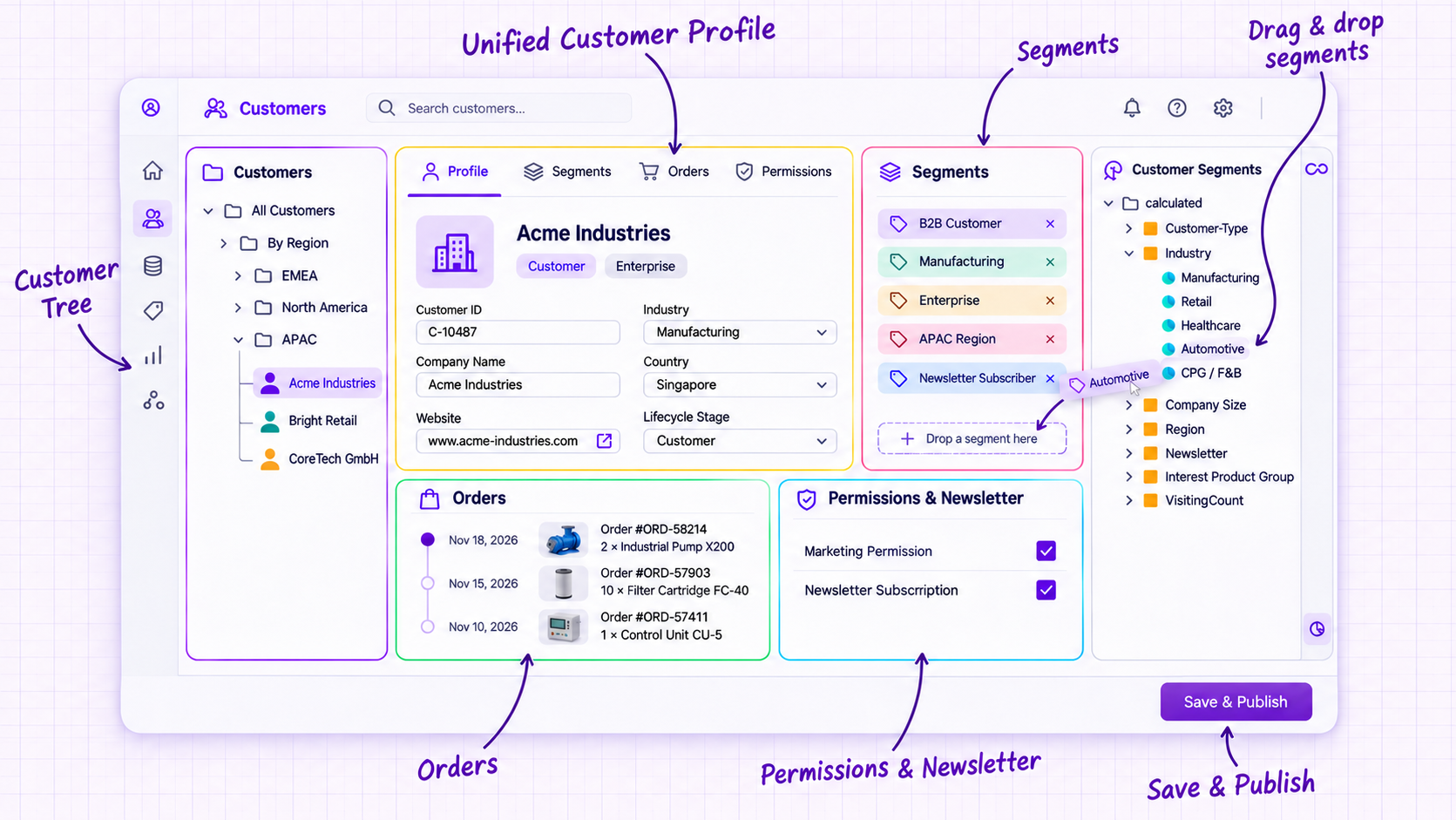
A retailer tracks baskets and loyalty points. A manufacturer tracks dealers, distributors, and the buyers behind them. Pimcore CDP models the customer the way your business sees it, then adds segmentation and automation where they save real time.
One customer model, adapted to your industry
Why it matters
These capabilities cover the core CDP job: collect the data, resolve who is who,
keep it clean, and get it to the channels that act on it.
Click any one to see how it works.
Pimcore's advanced data modeling allows businesses to create tailored, scalable, and highly adaptable data models for any industry. With over 45 customizable data components, Pimcore’s no-code interface simplifies the creation and management of complex data relationships across structured, unstructured, and binary assets.
FeaturesPimcore unifies structured, unstructured, and binary data into customizable models, forming the backbone of a smart data management strategy. This powerful framework is central to Pimcore, making it the ideal solution for managing any data type, complexity, or volume.
FeaturesPimcore’s integrated Data Quality Management offers a comprehensive toolset to ensure the highest standards of data quality, leveraging real-time reporting, automated enforcement, and AI-powered insights to maintain data integrity and accuracy.
FeaturesPimcore’s API-first approach offers flexible and powerful tools for data onboarding, including integrated ETL processes, data matching, cleansing, and various interfaces like the Pimcore Data Hub and Product Experience Portals.
FeaturesPimcore’s data distribution capabilities ensure efficient, real-time data sharing across various channels and systems. By leveraging flexible integration options and automated workflows, it streamlines data distribution for enhanced operational efficiency and consistency.
FeaturesPimcore’s Workflow Automation centralizes and streamlines data and experience management with a sophisticated workflow engine, visual designer, and integration with third-party tools like Teams and Slack. Pimcore Copilot further enhances automation through AI/ML-powered assistance.
FeaturesPimcore's AI-driven automation with the Pimcore Copilot enhances data and experience management, ensuring businesses stay ahead of the competition. With integrations to tools like Power Automate, Zapier, and n8n, it delivers tailored automation, boosting efficiency, ROI, and time to market.
FeaturesPimcore’s robust user management system supports large-scale data and experience management, offering secure SSO, 2FA, and detailed role and rights management down to the field and content level, ensuring compliance and security in global enterprise environments.
FeaturesPimcore’s Data Ingestion capabilities consolidate customer data from diverse sources into a unified profile. With real-time data processing, activity tracking, and identity resolution, businesses can achieve a comprehensive, cross-device customer view for personalized engagement.
FeaturesPimcore’s Integrated DXP combines CDP, E-Commerce, and DXP capabilities into a single platform, enabling brands to deliver personalized, data-driven experiences across all channels. With single-source publishing and easy access to product and customer data, Pimcore’s DXP streamlines content creation, enhances personalization, and ensures consistent, engaging customer journeys.
FeaturesNot ready to talk yet?
Pimcore's CDP runs on the Customer Management Framework, which is part of the Enterprise edition. Compare what each edition includes before you plan your project.
Sources
CRM
ERP
BI tools
Web and behavior tracking
Pimcore platform
PIM · MDM
DAM
DXP / CMS
Digital Commerce
Activation
MailChimp and newsletter tools
Marketing platforms via Data Hub
On-site personalization
Teams · Slack
Integration
REST · GraphQL
Data Hub webhooks
CSV · XML · JSON · XLSX
n8n · Zapier · Power Automate
Nissan
Automotive & Vehicles
Nissan uses DXP / CMS and DAM to deliver 11% Increased conversion rate.
LEDVANCE GmbH
Manufacturing
LEDVANCE GmbH uses DXP / CMS and PIM / MDM to deliver 60% Shortened Time to market.

4youCard – Jugendkarte des Landes OÖ
Government & Public Sector
4youCard – Jugendkarte des Landes OÖ uses Digital Commerce and DXP / CMS to deliver 40% less data maintenance.
One platform
Comparing Options
An evidence-based, capability-by-capability comparison for enterprise CDP, including where each one fits. No sign-up needed.
A CRM manages customer interactions for sales and service. A CDP consolidates customer data from every source into unified profiles that drive segmentation, marketing automation, and real-time personalization. Many companies run both, with the CRM as one of the CDP's sources.
Any company that wants to act on customer data across channels. The fastest start is usually unified profiles plus a few targeted campaigns built on segments.
A data warehouse or lakehouse serves analytics and reporting. A CDP works at the level of the individual profile, so you can act on it in real time. Customer 360 is the unified view a CDP produces.
Yes. Pimcore CDP runs on the same core as PIM, DAM, MDM and DXP, so a customer profile can reference the products, assets and pages that person interacts with. One data model, one API layer, one permission system. If you already run Pimcore, you activate the CDP instead of integrating a separate vendor.
Those are SaaS products: your customer data lives in the vendor's cloud. Pimcore is open core and you run it yourself, on your own infrastructure or on Pimcore PaaS, and it is licensed by edition rather than by profile volume. Pimcore also carries PIM, DAM and MDM on the same core, so customer data sits next to product and asset data. Pure-play CDPs ship more marketing connectors out of the box.
Pimcore licenses by edition, not by customer profile, user seat or API call. The Customer Data Platform is part of the Enterprise Edition, which starts at 29,900 $ per year including commercial licensing, support and SLAs. Pimcore PaaS starts at 39,900 $ per year and adds managed hosting, operations and 24/7 support. Because nothing is priced per profile, your licence cost stays flat as your customer base grows.
Data from APIs such as ERP, CRM, and BI tools, real-time behavior events via webhooks, and batch file feeds in CSV, XML, JSON, or XLSX. Product, master, and asset data from Pimcore PIM, MDM, and DAM can add context to every profile.
Identity resolution links records across devices and sources, and the duplicates service detects and merges matching customers. The result is one profile per person, with its activity history and an audit trail.
Yes. Segments update from profile data and activities, and a rule engine fires actions when conditions are met. Data moves in and out through GraphQL, REST, and outbound Data Hub webhooks. Actual latency depends on your setup and connected systems.
CRM, ERP, and BI systems as sources, real-time web and behavior tracking, a built-in newsletter sync such as MailChimp, and export to other marketing platforms through the Data Hub, automation tools, or the core API.
Yes. Segments drive on-site personalization in Pimcore and can be synced to newsletter tools and other marketing platforms, so each channel works from the same audience.
Dynamic segments based on data and behavior, dashboards, and connections to third-party reporting tools such as Power BI or Tableau.
Consent and preference management with an audit trail, tools to answer information requests, and logging of backend actions with timestamp, user, and action. Full GDPR compliance also depends on how you implement and operate the platform.
Permissions go down to field and content level. SSO and 2FA are available, and 2FA can be enforced for all users. Audit trails show who changed what.
Pimcore is built for large data volumes and enterprise workloads, and runs in the cloud, on-premises, or on Pimcore PaaS. Processing can run inside Pimcore or be triggered through webhooks. Sizing depends on profile and event volume, which the Pimcore team and partners assess with you during discovery.
We will use your personal data solely to process your request. For a better localized experience, we might share your data with certified solution partners in your geographical region. For more information, please read our privacy policy.
Copyright © 2026 Pimcore, All Rights Reserved | Imprint | Privacy Policy | General Terms & Conditions (PTC) | TOMs