
.jpg?width=2752&height=1536&name=unnamed%20(2).jpg)
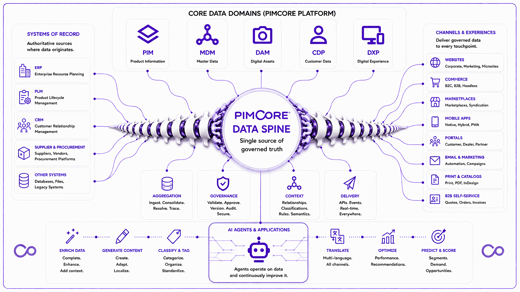
The Pimcore Data Spine is the architectural concept that defines how Pimcore sits at the center of enterprise data, experience, and AI infrastructure.
It is not a new product. It is the articulation of something Pimcore has been building for more than a decade — a unified, governed, extensible platform that connects the systems that produce data, the domains that structure data, the channels that consume data, and the AI that amplifies data.
Think of the Data Spine as the central nervous system of the enterprise. Not the brain. Not the muscles. The spine — the structure that connects everything, carries signals in both directions, and keeps the entire organism aligned and functioning.
The Four Layers of the Data Spine
The Data Spine connects four distinct layers of the enterprise architecture. Understanding these layers is critical to understanding why a unified platform matters — and why point solutions cannot replicate this.
Layer 1: Systems of Record
These are the upstream systems where data originates. ERP, PLM, supplier systems, CRM, procurement platforms. These systems are authoritative for their own domain — the ERP knows the cost price, the PLM knows the bill of materials, the supplier system knows availability.
The Data Spine does not replace these systems. It connects to them, ingests their data, and resolves the conflicts that inevitably arise when multiple systems describe the same entity differently.
Layer 2: Core Data Domains
This is where Pimcore's native capabilities live. PIM for product data. DAM for digital assets. MDM for master data across any domain — customers, suppliers, locations, materials. CDP for customer profiles and behavioral data. And the DXP layer for content and experience management.
These are not separate modules bolted together. In Pimcore, they share a common data model, a common permission system, a common workflow engine, and a common API layer. A product entity in PIM can reference assets in DAM, relate to master data records in MDM, connect to customer segments in CDP, and surface in content through DXP — all within a single, coherent platform.
This is the core of the Data Spine. The governed, structured, unified data layer where truth is established.
Layer 3: Channels and Experiences
Downstream from the governed data layer sits the distribution layer. Websites, e-commerce platforms, marketplaces, mobile apps, customer portals, marketing automation systems, print catalogs, dealer portals, B2B self-service platforms.
The Data Spine delivers governed data to every channel — consistently, in real time, and at scale. Not copies of data. Not exports. Living, governed data that is always current, always consistent, and always traceable back to its source.
Layer 4: AI Agents and Applications
This is the newest and fastest-growing layer. AI systems that consume data from the spine to generate content, automate workflows, optimize operations, and power intelligent experiences.
This layer is bidirectional. AI agents consume data from the spine. But they also produce data that flows back into it — enriched product descriptions, generated translations, classified entities, predicted segments. The Data Spine governs both directions, ensuring that AI-generated data meets the same quality standards as human-curated data.
What the Data Spine Actually Does
It Aggregates
The Data Spine connects to all relevant systems and consolidates data into a unified layer. Product data from the ERP, enrichment data from suppliers, pricing data from commerce systems, asset metadata from creative tools — all brought together, deduplicated, and reconciled.
This is not a simple merge. It is an intelligent aggregation that understands precedence rules, handles conflicts, and maintains lineage. When the ERP says a product is "active" and the PIM says it is "pending review," the Data Spine knows which system is authoritative for which attribute and resolves the conflict according to configurable business rules.
It Governs
Data without governance is noise. The Data Spine applies structure, validation, and quality controls across every data domain.
This results in: mandatory attributes are enforced. Data types are validated. Business rules are applied. Workflows ensure that data moves through the right approval processes before it reaches any channel. Versioning ensures that every change is tracked and reversible. Permissions ensure that the right people can see and edit the right data.
Governance is not an afterthought. It is the central function of the spine.
It Provides Context
Raw data is rarely useful. A product weight of 2.3 kg means nothing without context — context like the target market (does this need to be displayed in pounds?), the channel (does the marketplace require it in a specific format?), the language (is the unit label localized?), and the classification (does this product belong to a category that requires specific data completeness?).
The Data Spine maintains this context. It understands that the same product entity needs different representations for different purposes — a detailed technical specification for the B2B portal, a lifestyle-oriented description for the consumer website, a classification-compliant dataset for the marketplace.
And critically, this context is what makes AI useful. An AI agent that has access to a product's full context — its classifications, its market-specific requirements, its related assets, its channel-specific rules — can generate genuinely useful output. An AI agent that has access to a flat CSV of product attributes cannot.
It Delivers
From the governed, contextualized data layer, the Data Spine distributes data to every touchpoint. APIs, webhooks, event-driven distribution, headless delivery.
The key principle: data is delivered, not copied. Downstream systems consume data from the spine in real time. They do not maintain their own copy. This eliminates the drift, staleness, and inconsistency that plague traditional architectures where every system maintains its own version of product, customer, or content data.