

The Most Flexible Way to Run Pimcore — Now With Infrastructure You Control in Real Time
Enterprise infrastructure has a dirty secret.
You are paying for capacity you do not use. Every day. Every month. Every year.
Your infrastructure is sized for the peak — Black Friday, the product launch, the seasonal campaign, the data migration. The other 350 days of the year, that capacity sits idle. You are paying for it anyway. Because traditional infrastructure packages are rigid. You pick a tier. You commit. And if your application needs more on Tuesday and less on Thursday, that is your problem.
This is how enterprise PaaS has worked for decades. Fixed tiers. Fixed resources. Fixed costs for variable workloads.
Today, we are changing that.
What Is Pimcore PaaS?
For those unfamiliar: Pimcore PaaS is the fully managed platform for deploying, running, and scaling Pimcore applications. Built on Upsun's proven infrastructure technology (formerly Platform.sh), it provides an end-to-end development, deployment, and quality assurance pipeline that fundamentally changes how teams work with Pimcore.
This is not just hosting. It is a complete DevOps pipeline — from local development to staging to production — with built-in environment cloning, automated deployments, rollback capabilities, and infrastructure-as-code. Development teams work faster. Deployments become predictable. Quality assurance happens in production-identical environments. And operations teams sleep better.
Pimcore PaaS is multi-cloud, running across major cloud providers. It is multi-region, deployable in data centers across Europe, North America, and beyond. And it is regulatory-compatible, supporting the data residency, sovereignty, and compliance requirements that enterprises in regulated industries demand — from NIS 2 and DORA to GDPR and industry-specific mandates.
Combined with Pimcore's deployment flexibility — public cloud, private cloud, managed PaaS, or on-premise — Pimcore PaaS represents the managed option for organizations that want the full power of the platform without the operational overhead of running infrastructure themselves.
But until today, Pimcore PaaS had the same limitation as every other managed platform: rigid resource packages.
That changes now.
Introducing Boosters
We call the new capability simply: Boosters.
Boosters represent a fundamentally new approach to infrastructure flexibility. Instead of committing to a fixed resource bundle and hoping it fits your workload 365 days a year, you commit to a base infrastructure level — and then boost resources dynamically, in real time, whenever your application needs more.
CPU. RAM. Storage. Any resource. Any time. For any duration.
Need more compute for a complex data import that runs for 45 minutes? Boost it. Running image transformation pipelines across 50,000 assets? Boost it. Black Friday traffic spike hitting at 8 AM? Boost it. Spike over by noon? Scale back down.
You are no longer locked into a static resource allocation that was designed months ago based on an estimate that turned out to be wrong. You control your infrastructure in real time, scaling resources up and down based on what your application actually needs — right now, not what someone predicted it would need six months ago.
This is not auto-scaling in the traditional sense, where a platform makes opaque decisions about your resources based on algorithms you cannot see. This is explicit, controllable, predictable scaling — where you decide what to boost, when to boost it, and for how long.
Flexible as hell. And finally, infrastructure that works for you — not the other way around.
How It Works
The Boosters model is built on a simple, transparent structure.
Step 1: Commit to a Base
You start with a base infrastructure commitment. This can be one of our predefined packages — Pimcore PaaS Growth or Pimcore PaaS Performance — or it can be a fully custom base infrastructure defined together with our team, tailored precisely to your application's baseline requirements.
The base commitment represents your steady-state infrastructure — the resources your application needs on a normal day, for normal operations. It is sized for your reality, not for your peak.
Step 2: Boost When You Need More
When your application needs more — whether that is more CPU for a batch process, more RAM for a complex query, more storage for a data migration, or more of everything for a traffic spike — you activate Boosters. Resources scale up immediately. Your application gets what it needs, when it needs it.
Boosters can run for minutes, hours, or days. There is no minimum duration. There is no scheduling requirement. You boost when you need to, and you stop boosting when you do not.
Step 3: Pay for What You Use
Additional resources consumed through Boosters are billed as overages, calculated against your base commitment. The pricing is transparent and predictable — you know your base cost, and you know the overage rates. No surprises. No hidden multipliers. No complex metering that requires a spreadsheet to understand.
The result: your base commitment covers your normal operations at a predictable cost. Boosters cover your peaks at a transparent, pay-as-you-go cost. You stop paying for idle capacity that exists only because your package was sized for a worst-case scenario.
No More Limits on Base Infrastructure
But Boosters are only half the story.
The other half is equally important: we are eliminating the rigid two-tier model.
Previously, Pimcore PaaS offered two predefined packages — Growth and Performance. Each came with a fixed set of included resources. If your application needed something between the two, or something beyond either, you were stuck. You either overpaid for a package that was too large, or you squeezed into a package that was too small.
That constraint is gone.
Starting with the new Pimcore PaaS model, Growth and Performance remain as convenient starting points — well-defined packages that fit a wide range of common deployment scenarios. But they are no longer the boundaries.
Together, we can define any base infrastructure that fits your application and project. Need more storage but less CPU than the standard Performance package? Done. Need a compute-heavy configuration for a data-intensive MDM deployment? Done. Need a geographically distributed setup with specific resource allocations per region? Done.
The base infrastructure is fully configurable. The Boosters sit on top of it. And the combination gives you a deployment model that is as unique as your application — without the cost of over-provisioning or the risk of under-provisioning.
No limits. No compromises. Infrastructure that fits.
Why This Matters for Pimcore Deployments
Pimcore is not a simple CMS. It is a data and experience management platform that runs complex workloads — product data imports from ERP systems, digital asset transformation pipelines, master data synchronization across domains, content delivery to multiple channels, and increasingly, AI agent operations that require significant compute resources.
These workloads are inherently variable. A product import that runs weekly needs significant resources for two hours and nothing for the rest of the week. An image transformation pipeline that processes 100,000 assets after a brand refresh needs massive compute for a day. Black Friday needs everything you have for 72 hours.
Static infrastructure packages force you to provision for the maximum across all of these scenarios, all of the time. Boosters let you provision for the baseline and scale for the peaks.
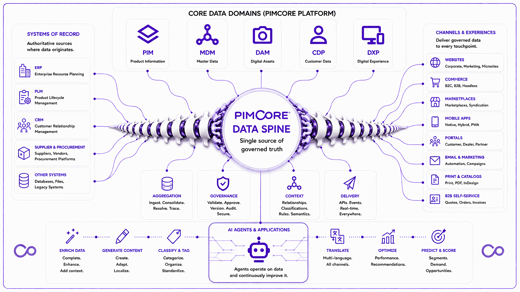
For enterprises running the Pimcore Data Spine as their central governed data layer, this flexibility is particularly relevant. The Data Spine connects systems of record, core data domains, channels, and AI agents — workloads that fluctuate based on business cycles, campaign schedules, and operational patterns. With Boosters, the infrastructure adapts to the workload. Not the other way around.
And as the Pimcore Agent SDK introduces AI agents as first-party participants in the platform, compute requirements will become even more variable. Agent-driven enrichment runs, classification tasks, content generation pipelines — these are workloads that spike when triggered and idle when complete. Boosters are architecturally designed for exactly this kind of demand pattern.
The Bigger Picture: Infrastructure as a Competitive Advantage
There is a broader point here that goes beyond resource management.
The enterprises that move fastest are the ones with the least friction between intent and execution. When a product team decides to launch in a new market, how long does it take before the infrastructure is ready? When a data team needs to run a one-time migration of 10 million records, do they wait three weeks for an infrastructure change request — or do they boost and run it today?
Boosters remove the infrastructure friction from business decisions. They turn what used to be a planning exercise into an operational decision. Need more? Boost. Done? Scale back. No tickets. No waiting. No over-provisioning as insurance against uncertainty.
Combined with Pimcore PaaS's existing capabilities — multi-cloud deployment, multi-region availability, environment cloning, automated deployments, and regulatory compliance — Boosters complete the picture of a managed platform that is genuinely designed for how modern enterprise applications actually operate.
Availability
Pimcore PaaS Boosters and the new flexible infrastructure model will be first previewed publicly at the Pimcore Inspire Conference on April 14, 2026.
The new capabilities will be generally available starting June 1, 2026.
Existing Pimcore PaaS customers will be able to transition to the new model. New customers can start directly with the flexible infrastructure approach.
For details on packages, pricing, and configuration options, contact our team or speak with us at Inspire.
Infrastructure Should Not Be a Constraint
For too long, managed platform infrastructure has been a trade-off. You got the convenience of managed operations, but you gave up flexibility. You got predictable costs, but you paid for capacity you did not use. You got a standard package, but it never quite fit your application.
Boosters end this trade-off.
Managed convenience. Real-time flexibility. Transparent costs. Custom base infrastructure. And the ability to scale resources up and down based on what your application actually needs — not what a package tier assumes it needs.
This is what Pimcore PaaS was built to be. And with Boosters, it finally is.
Infrastructure should not be a constraint. It should be a capability.
Now it is.
Read more: About Pimcore PaaS