

Why We Built AI Agents Into the Core of the Platform — and What That Changes for Enterprises
For the past two years, the enterprise software industry has been in a race to add AI. Every platform now has an AI button. Every vendor now has an AI story. Every product roadmap now has an AI chapter.
Most of it is decoration.
A chatbot layered on top of a search interface. A "generate description" button that calls an LLM API. A co-pilot sidebar that has no understanding of the data it is supposed to help manage. Features that look impressive in a demo and collapse under the weight of real enterprise complexity.
This is not what enterprises need.
What enterprises need is not AI as a feature. They need AI as a participant — an operational co-worker that understands the data, respects the rules, and does real work within the governed boundaries of the platform.
That is what the Pimcore Agent SDK is.
What We Are Announcing
At the Pimcore Inspire Conference on April 14, 2026, we are releasing the beta of the Pimcore Agent SDK — a framework deeply embedded in the core of Pimcore that makes AI agents first-class participants in the platform.
Not a plugin. Not an integration layer. Not a wrapper around an LLM API.
A foundational framework that treats agents the same way the platform treats human users — as participants with identity, permissions, context, and accountability. Agents that operate through the same governed channels as every other actor in the system.
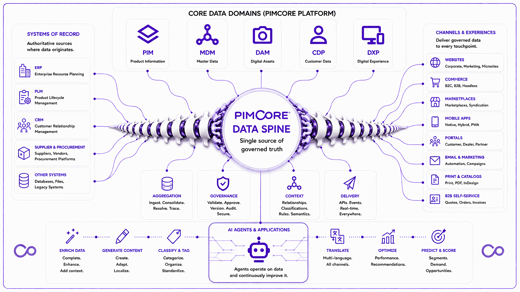
This is the next logical step in the evolution of the Pimcore Data Spine. The Data Spine provides the trusted, governed, structured data foundation. The Agent SDK provides the intelligence layer that operates on top of it.
Together, they enable a new operating model: Agentic PXM — where humans define intent, agents execute and optimize, and the platform governs everything.
The Problem With AI in Enterprise Software Today
Before explaining what the Agent SDK is, it is worth understanding what it is designed to replace.
The current state of AI in enterprise platforms falls into three categories. All of them are inadequate.
The API Wrapper
The most common approach. The vendor exposes a button — "Enrich with AI," "Generate Description," "Translate" — that sends data to an LLM API and writes the response back into a field. Sometimes with a prompt template. Sometimes with basic post-processing.
This works for isolated tasks. It does not work for enterprise operations.
Why? Because the LLM has no context. It does not know the data model. It does not understand the business rules. It does not know that this product is in a regulated category that requires specific attribute completeness. It does not know that this description needs to follow brand guidelines for the DACH market but different guidelines for North America. It does not know that the previous version of this description was rejected by the editorial team for a specific reason.
Without context, the AI is guessing. And in enterprise data management, guessing is not acceptable.
The Co-Pilot Sidebar
A step up from the API wrapper. A conversational interface that sits alongside the platform and can answer questions about data, suggest actions, and assist with tasks.
Better — but still limited.
This is valuable — and it is where most platforms are today, including Pimcore's current AI capabilities. Co-pilots help users navigate complex data, surface insights, and accelerate decisions. They are a meaningful step forward from static interfaces.
But a co-pilot is, by definition, a passenger. It observes the platform. It can suggest. It can assist when asked. But it cannot act autonomously. It cannot monitor data quality at 3 AM. It cannot enrich ten thousand products overnight. It cannot detect an anomaly in incoming supplier data and trigger a workflow before a human even notices the problem.
Co-pilots are where the journey begins. But the destination is different. The destination is co-workers — AI agents that do not just assist, but act. Autonomously, continuously, within governed boundaries.
The Pimcore Agent SDK is the architecture that takes us from co-pilot to co-worker. Not overnight — but deliberately, through a staged evolution where enterprises control how much autonomy agents earn, step by step.
Co-pilots are helpful assistants. Enterprises need co-workers.
The External AI Layer
Some organizations build their own AI orchestration on top of the platform — custom pipelines, LangChain workflows, proprietary agent frameworks that interact with the platform via API.
This can be powerful. It is also fragile, expensive to maintain, and fundamentally disconnected from the platform's governance layer. External agents do not go through the platform's permission system. They do not trigger the platform's workflows. They do not respect the platform's validation rules — unless someone builds all of that logic again, outside the platform.
Which means: every time the data model changes, the external AI layer breaks. Every time a workflow is updated, the external AI layer needs to be updated. The result is a parallel system that mirrors the platform's logic imperfectly and degrades over time.

-1.svg)
.svg)
.svg)
.png?width=24&height=24&name=Data%20and%20Experience%20icons%20(1).png)
.svg)


