

Why the Next Era of Enterprise Software Demands a New Foundation — and What That Foundation Looks Like
For more than a decade, enterprises have poured resources into digital transformation. They implemented ERP systems, product information management, digital asset management, content management, commerce platforms, customer data platforms, and more. Each system promised a piece of the puzzle.
And each system delivered — on its own terms.
Though there is an uncomfortable truth most vendors will not say out loud:
The more systems you implement, the worse your data problem gets.
Every new platform creates a new data silo. Every integration creates a new reconciliation headache. Every department builds its own version of the truth. And the people who are supposed to create value — product managers, marketers, salespeople, operations teams — spend the majority of their time not creating anything. They spend it finding, cleaning, reconciling, and arguing about data.
This is the state of enterprise data in 2026.
And it is about to get dramatically worse.
The AI Inflection Point
AI has moved from experiment to infrastructure. Large language models, generative systems, and autonomous agents are becoming the operational backbone of modern enterprises. Companies that six months ago were running proof-of-concept pilots are now deploying AI into production workflows — content creation, product enrichment, customer interaction, supply chain optimization, pricing, and beyond.
And guess what! AI has a dependency that most organizations underestimate.
AI is only as good as the data it consumes.
This is not a theoretical concern. It is a structural one.
When an AI agent pulls product data from three different systems and gets three different answers, it does not flag the inconsistency. It picks one. Or worse — it blends all three into something that is confidently wrong. When an AI-powered recommendation engine operates on incomplete customer profiles because the CDP and CRM disagree on segment definitions, the output is not slightly off. It is systematically misleading.
Fragmented data does not just make AI less effective. It makes AI dangerous.
Inconsistent input produces inconsistent output. Missing context leads to wrong decisions. Fragmentation causes AI drift — a slow, compounding divergence between what the AI believes and what is true.
In a world without AI, fragmented data was inefficient.
In a world with AI, fragmented data is an existential risk.
Why Traditional Integration Does Not Solve This
The instinctive response to data fragmentation is integration. Build APIs. Connect systems. Sync data. And there is an entire industry built around this instinct — iPaaS platforms, middleware, ESBs, data pipelines, ETL tools.
These tools move data. They do not govern it.
Moving data between systems faster does not solve the fundamental problem. If your ERP says a product weighs 2.3 kg and your PIM says it weighs 2.5 kg, syncing them in real time just propagates the conflict at the speed of light. You now have a real-time inconsistency instead of a batch inconsistency. That is not progress.
What is missing is not connectivity. What is missing is authority.
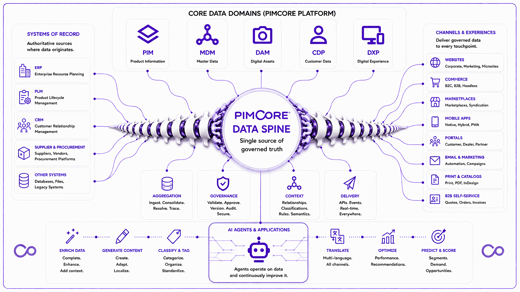
Enterprises need a layer that does not just connect data — it owns data. A layer that defines what is true, enforces quality, resolves conflicts, and provides a single, governed, authoritative version of every critical data entity.
A layer that is not a pipe. But a spine.


-1.svg)
.svg)
.svg)
.png?width=24&height=24&name=Data%20and%20Experience%20icons%20(1).png)
.svg)


