

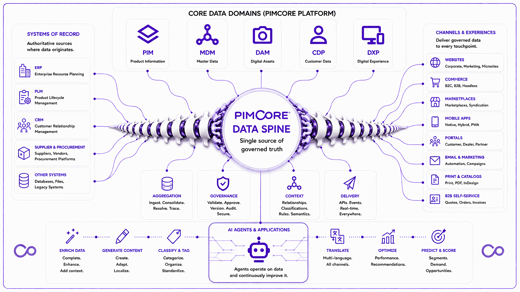
Let us be specific about what the Data Spine architecture delivers.
Elimination of data silos. One governed layer instead of dozens of disconnected systems each holding their own version of the truth.
Reduced operational cost. Less time spent reconciling data. Less time spent on manual enrichment. Less time spent debugging inconsistencies across channels. The Data Spine does not eliminate human work. It redirects it from low-value reconciliation to high-value curation and strategy.
Faster time to market. When product data is governed centrally and distributed automatically, launching a new product on a new channel is a configuration task — not a six-week integration project.
Higher data quality. Governance is not optional. It is structural and business critical. Validation rules, completeness checks, approval workflows, and quality scoring are built into the data lifecycle.
Scalable AI adoption. The Data Spine provides the foundation that AI needs. Organizations can deploy agents incrementally — starting with simple enrichment tasks and scaling toward autonomous operations — without rebuilding their data foundation each time.
Data sovereignty and control. In a market increasingly dominated by black-box SaaS platforms and opaque AI systems, the Data Spine ensures that enterprises remain in control of their data, their logic, and their customer relationships.
Pimcore did not pivot to this architecture when AI became trendy. Pimcore has been building toward this for more than a decade.
The decision to build PIM, DAM, MDM, CDP, and DXP on a single, unified platform — with a common data model, a common API, and a common governance layer — was not just a technical choice. It was an architectural bet. A bet that the future would reward platforms that unify data over platforms that fragment it.
That bet is paying off. And the market is recognizing it.
Validated by Industry Analysts
In April 2026, Pimcore was included in the Gartner Magic Quadrant for Master Data Management Solutions — placing Pimcore among the most important and relevant vendors in the MDM space globally.
This is Pimcore's second Gartner Magic Quadrant. The first was for Digital Experience Platforms.
Two Magic Quadrants. Two domains. One platform.
This is significant because it validates the core thesis of the Data Spine. Pimcore is not just a PIM vendor that added a few features. It is the only platform recognized by Gartner in both structured data management (MDM) and unstructured experience management (DXP) — the two fundamental pillars of enterprise data.
MDM governs the structured side: products, customers, suppliers, locations, materials — the master data entities that drive operational processes. DXP governs the unstructured side: content, pages, templates, experiences — the web and digital layer that drives customer engagement.
The Data Spine connects both. And the fact that independent analysts now recognize Pimcore's relevance in both domains is not a coincidence. It is the result of an architectural strategy that has always treated structured and unstructured data as two sides of the same coin — unified in one platform, governed by the same rules, accessible through the same APIs, and now amplified by the same AI agents.
For enterprises evaluating their data foundation, this dual recognition matters. It means that the platform managing your product master data is the same platform managing your digital experiences. No integration required. No reconciliation needed. One spine.
Because in the age of AI, three things determine whether a platform is a strategic asset or a legacy liability:
Data is the foundation. Without governed, structured, high-quality data, nothing else works. Not AI. Not personalization. Not automation. Not compliance.
Context is the differentiator. Raw data is a commodity. Contextual data — data that carries relationships, semantics, rules, and provenance — is what enables intelligent operations. The Data Spine provides this context.
Governance is the requirement. Regulators, boards, and customers are demanding transparency, control, and accountability. Platforms that treat governance as a checkbox will not survive. Platforms that make governance structural will.
The Question Every Enterprise Should Ask
AI will not replace your enterprise systems.
It will amplify them.
If your systems produce clean, governed, contextual data — AI will amplify that quality into faster operations, better experiences, and smarter decisions.
If your systems produce fragmented, inconsistent, ungoverned data — AI will amplify that chaos into compounding errors, regulatory risk, and operational drift.
The question is simple:
Does your data foundation provide something AI can trust?
With the Pimcore Data Spine, the answer is yes.


-1.svg)
.svg)
.svg)
.png?width=24&height=24&name=Data%20and%20Experience%20icons%20(1).png)
.svg)


