

This post is part of a special blog series covering key announcements, sessions, and behind-the-scenes moments from Pimcore Inspire 2026 in Salzburg, Austria. We’ll be updating this space with links to all related posts as they go live — so you can follow along with everything that’s happening during this unforgettable event. Because yes — this is huge. 🚀
- Pimcore Inspire 2026
- The Pimcore Data Spine
- Introducing the Data Spine
- The Pimcore Agent SDK
- The Data Spine and Agentic PXM
- The Relationship between the Data Spine and Agent SDK
- The Strategic Advantage — Built for This Moment and Beyond
- Why the Data Spine matters now more than ever
- Pimcore Platform Version 2026.1
- Pimcore Included in Gartner® Magic Quadrant™ for MDM 2026 – It's a Significant Recognition for us.
A New Era of Data and Experience Management
Every platform has releases. Version numbers tick upward. Changelogs grow. Features accumulate.
Most of the time, a release is exactly that — an increment. A step forward on a continuous path.
Pimcore Platform Version 2026.1 is not an increment.
It is a turning point.
With this release, Pimcore completes a multi-year architectural transformation, delivers the General Availability of Pimcore Studio, and establishes the foundation on which everything that comes next — including the Pimcore Agent SDK and the vision of Agentic PXM — will be built.
This is the release that draws the line between what Pimcore was and what Pimcore becomes.
Pimcore Studio: Generally Available
After more than two years of continuous development, testing, iteration, and production hardening, Pimcore Studio is now generally available and fully supported for enterprise use.
Studio is fully available for both Pimcore Platform Version 2026.1 and Version 2025.4. This is an important detail. Version 2025.4 is the last Pimcore release that runs both the legacy ExtJS-powered Admin UI and Pimcore Studio side by side — giving organizations a smooth transition path. They can adopt Studio at their own pace on 2025.4, running both interfaces in parallel, and then move to 2026.1 when they are ready for the clean, Studio-only architecture. There is no forced migration. There is a deliberate, well-supported transition.
This deserves more than a bullet point in a changelog. It deserves context.
Why Studio Matters
Pimcore Studio is not a redesign. It is a reimagination of how organizations interact with enterprise data and experience management — across every domain Pimcore covers.
The previous Admin UI — built on ExtJS — served Pimcore well for years. It was powerful, dense, and capable. But it was also a product of its time. The technology stack was aging. The user experience reflected the assumptions of an era when enterprise software was expected to be complex, and complexity was equated with capability.
That era is over.
Modern enterprise users expect interfaces that are fast, intuitive, and responsive. They expect workflows that guide them rather than overwhelm them. They expect a platform that adapts to how they work — not the other way around.
Pimcore Studio delivers this. A modern, highly responsive interface designed for the full spectrum of data and experience management. Product data, digital assets, content, customer data, master data — all managed through a unified, coherent experience that reduces cognitive load and accelerates every workflow.
But the significance of Studio goes far beyond usability.
The Architectural Foundation
Studio is not just a new frontend. It is a new architectural layer — built on a modern, proven technology stack.
The Studio UI is built with React, Ant Design, TypeScript, Redux, RTK Query, Mercure, and Rsbuild. This is not a custom framework or a niche technology bet. It is the mainstream modern web stack — the same technologies that power the most demanding web applications in the world. TypeScript provides type safety and developer productivity. React provides component-based rendering with surgical updates — only the parts of the interface that change are re-rendered, making the entire experience feel like a true modern web application. Ant Design provides a comprehensive, battle-tested component library. Redux and RTK Query handle state management and API communication. Mercure enables real-time updates via Server-Sent Events, so changes made by one user — or by an agent — appear instantly for everyone.
The Studio Backend is equally deliberate. It provides a fully OpenAPI-documented REST API for all Pimcore operations — assets, data objects, documents — accessible via Swagger UI in the development environment. The API is not an afterthought bolted onto an existing UI layer. It is the foundation. Studio UI is a client of this API, and so is every custom extension, every integration, and every agent. This means that anything Studio can do, a custom application or an agent can do — through the same governed, documented interface.
Behind the API sits the Generic Execution Engine for background task processing, a comprehensive event system for customization hooks, a configurable grid system with filters and data transformers, and a perspective and widget system for UI customization. Studio also requires a search engine backend — Elasticsearch or OpenSearch — which makes searching, filtering, and loading of large datasets significantly faster and more scalable than the legacy approach.
Built on modern web technologies with a clean separation between frontend and backend, Studio introduces an extensibility model that fundamentally changes what is possible on top of Pimcore.
The Studio SDK gives partners and developers a first-class interface for building custom extensions, tailored workflows, and domain-specific solutions — directly within the Pimcore ecosystem. Not as fragile hacks against an internal API. Not as workarounds against undocumented behavior. As structured, supported, versioned extensions that integrate seamlessly with the platform's UI, data layer, and permission system.
The SDK provides a formal plugin architecture with a clear lifecycle model. This means extensions are not patches on top of Studio. They are first-class participants in its lifecycle.
The SDK ships with comprehensive TypeScript definitions for strong typing, a dedicated Rsbuild plugin that defines entry points and streamlines the build process, and Storybook — an interactive library showcasing all available UI components with their configurations and variations in a live, browsable format. Developers can see exactly how components look and behave in isolation before integrating them into their extensions. Pimcore also provides the Studio Example Bundle on GitHub — a complete, working reference implementation with various examples of how to extend the Studio UI, from custom tabs and editors to new widgets and integrations.
This is what makes Studio strategic. It is not just better for users. It is better for the ecosystem. Every partner that builds on Pimcore, every system integrator that delivers projects, every enterprise that customizes the platform for its specific needs — all of them now have a modern, stable, extensible foundation to build on.
And critically, Studio is the interface through which the next generation of Pimcore capabilities will be delivered. The Pimcore Agent SDK, agentic workflows, AI-assisted data management — all of these will surface through Studio. The GA of Studio is not the end of a UI project. It is the starting line for a new phase of innovation.
What This Means in Practice
For business users: faster workflows, less friction, fewer clicks to get work done. A modern interface that feels like a product built in 2026, not 2012. Onboarding new team members becomes easier because the interface communicates intent clearly rather than hiding it behind layers of menus and configurations.
For developers and partners: the Studio SDK opens up a structured extensibility model with a formal plugin architecture, dependency injection, TypeScript types, and Storybook for component exploration. The Studio Example Bundle provides working reference implementations to get started fast. Build custom views, integrate third-party services, create domain-specific tooling — all within a supported framework. Less time spent fighting the UI layer. More time spent creating value.
For organizations: a unified, future-ready interface that supports modern workflows, continuous innovation, and the transition toward agentic operations. No more maintaining parallel UI systems. No more making peace with technical debt. A clean platform for the next decade.
End of Admin UI Classic: A Clean Break
Platform Version 2026.1 completes the transition away from the Admin UI Classic. All remaining dependencies on the legacy ExtJS-based interface have been removed from the codebase.
This is a deliberate decision and it is worth explaining why it matters.
Maintaining two parallel UI systems is not just a technical inconvenience. It is an architectural drag. Every feature needs to be considered for both interfaces. Every extension needs to work in both contexts. Every security update, every performance optimization, every API change carries twice the surface area.
More importantly, a legacy UI layer constrains innovation. When the platform has to maintain backward compatibility with an aging frontend framework, it cannot move as fast, as boldly, or as cleanly as it needs to.
By completing the removal of Admin UI Classic, Pimcore Platform 2026.1 eliminates this constraint entirely. The codebase is cleaner. The architecture is unified. The development team can focus 100% of its energy on the modern stack — Studio, the Studio SDK, and the capabilities that sit on top of them.
For organizations running Pimcore: this is a clear signal. The path forward is Studio. The investment in modern infrastructure is complete. There is no ambiguity about where the platform is going. And for organizations that need a transitional step, Version 2025.4 remains available with both interfaces running in parallel — a deliberate bridge between the old and the new.
Unified Versioning: Clarity at Scale
Starting with Platform Version 2026.1, Pimcore introduces a unified versioning scheme across all bundles. Every component follows the same version number as the platform itself.
This sounds like a small change. It is not.
Anyone who has managed a Pimcore project — or any enterprise platform with multiple interdependent components — knows the pain of version matrix management. Which version of bundle X is compatible with which version of the core? Did the latest update of bundle Y break the integration with bundle Z? Which combination of versions is actually tested and supported?
Unified versioning eliminates this entire class of problems. When the platform is version 2026.1, every bundle is version 2026.1. Compatibility is guaranteed by definition. Dependency management becomes trivial. Project maintenance becomes predictable.
This does not introduce any functional changes. It is a structural improvement — the kind of structural improvement that compounds over time, reducing friction in every project, every upgrade, every support interaction.
Streamlined Bundle Ecosystem
As part of this major release, Pimcore has consolidated and streamlined its bundle landscape. Several legacy bundles have been removed or replaced by capabilities now natively integrated into Pimcore Studio.
Advanced object search, the simple backend search, the perspective editor — these are no longer separate bundles with separate lifecycles. They are built into Studio. Maintained as part of the core. Governed by the same release cycle and quality standards as the rest of the platform.
Additional bundles that no longer align with the platform's strategic direction have been discontinued.
The result is a leaner platform. Fewer moving parts. Less fragmentation. A stronger focus on the capabilities that matter — core data management, experience delivery, extensibility, and the emerging agent layer.
This is not about removing features. It is about consolidating them into the right place. When capabilities are native to the platform rather than distributed across optional bundles, they are more reliable, more consistent, and easier to maintain.
Simplified Development Experience
Platform Version 2026.1 introduces a streamlined installer that significantly improves the Pimcore development experience.
The installation and onboarding process — historically one of the steeper parts of the Pimcore learning curve — has been refined to reduce setup complexity and shorten the path from zero to running instance.
For development teams, this means faster project starts. For partners, it means more efficient delivery. For the ecosystem as a whole, it means lower barriers to entry and faster time-to-value on every new project.
This improvement is part of a broader commitment to developer experience that runs through the entire 2026.1 release — from the Studio SDK with its TypeScript definitions, Storybook component library, and hot module replacement for live reloading during development, to unified versioning, to the streamlined bundle architecture. Every change is designed to make building on Pimcore faster, more predictable, and more enjoyable.
Core Improvements Under the Hood
As a major release, Platform Version 2026.1 includes a range of technical improvements across the core system and key components.
Performance optimizations in data export, refinements in ecommerce functionality, improvements in data quality management, and various fixes across the platform. Many of these changes operate behind the scenes, but they collectively contribute to a more robust, scalable, and future-proof foundation.
Breaking changes have been addressed carefully, with clear documentation and migration paths. The goal — as always with a major Pimcore release — is to balance forward progress with respect for the investment organizations have already made in the platform.
The Bigger Picture: Why This Release Is Strategic
It is tempting to read a release announcement as a list of features. But Platform Version 2026.1 is better understood as the completion of a multi-year transformation — and the beginning of the next one.
The Transformation That Is Complete
Over the past two years, Pimcore has executed one of the most ambitious architectural transitions in the enterprise software space:
A complete replacement of the legacy frontend framework. A reimagined user experience. A new extensibility model. A unified versioning scheme. A consolidated bundle ecosystem. A streamlined development experience.
All of this while maintaining backward compatibility, supporting production customers, and continuing to deliver functional improvements.
With 2026.1, this transformation is done. The technical debt is cleared. The architecture is modern. The foundation is clean.
The Transformation That Begins
What makes this release truly strategic is not what it concludes — it is what it enables.
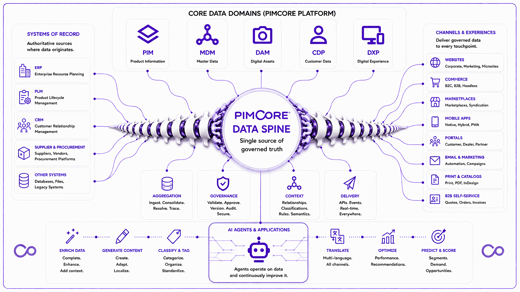
The Pimcore Data Spine — the governed, unified data backbone that connects systems, domains, channels, and AI — is now built on a modern, extensible platform without legacy constraints.
The Pimcore Agent SDK — the framework that makes AI agents first-party participants in the platform — will surface through Studio's modern interface, leverage the Studio SDK for custom agent UIs, and operate within the clean architecture that 2026.1 establishes.
Agentic PXM — the operating model where humans define intent, agents execute, and the platform governs — requires a foundation that is modern, extensible, performant, and clean. Whether the use case is product experience management, master data governance, digital asset orchestration, or content delivery, Platform Version 2026.1 is that foundation.
Every architectural decision in this release — Studio GA, the removal of Admin UI Classic, unified versioning, bundle consolidation, the streamlined installer — was made not just to improve the present, but to enable the future.
What This Means for Partners
For Pimcore's partner ecosystem, Platform Version 2026.1 is a catalyst.
The Studio SDK provides a modern, structured extensibility model that unlocks new categories of solutions. Partners can build custom extensions, industry-specific workflows, vertical solutions, and differentiated offerings — all within a supported, documented framework.
Unified versioning simplifies project management and reduces the support burden. The streamlined installer accelerates project delivery. The consolidated bundle ecosystem means fewer integration surprises and more predictable upgrades.
And looking ahead: the Agent SDK, built on the architecture that 2026.1 establishes, will open an entirely new dimension of partner opportunity — building, configuring, and deploying intelligent agents for specific enterprise use cases.
The platform is ready. The ecosystem can build.
Looking Ahead
Pimcore Platform Version 2026.1 is the beginning of a new phase.
With Studio generally available, the legacy UI removed, and the architecture modernized, Pimcore is now fully focused on what comes next: innovation, extensibility, and intelligent automation.
The Data Spine provides the governed data foundation. The Agent SDK provides the intelligence layer. Studio provides the interface. And Platform Version 2026.1 provides the clean, modern, extensible architecture that connects all of it.
This is the platform for the next era of data and experience management — where structured and unstructured data, content, and customer experiences are orchestrated seamlessly across channels, governed structurally, and amplified by AI agents that operate as first-class participants in the system.
The foundation is set. The journey continues.
Stay informed with Pimcore Inside
Get an exclusive look behind the scenes of Pimcore Product Development with the ongoing Pimcore Inside video series on YouTube. Hear directly from the team building and evolving the Pimcore Platform as they share insights into the latest innovations, upcoming product roadmaps, and key technology developments.

From new features and architectural improvements to technical deep dives and a closer look at what's coming next, Pimcore Inside gives you a first-hand perspective on how the platform continues to evolve and how these advancements can help you get even more value from Pimcore.


-1.svg)
.svg)
.svg)
.png?width=24&height=24&name=Data%20and%20Experience%20icons%20(1).png)
.svg)


